
The VW Golf Steering Wheel Guide: GTI, GTD and R
A platform-by-platform guide to the VW Golf steering wheel upgrade: Golf 7 and Golf 8 GTI and R fitment checks, donor cores, factory functions and coding conditions.
Read More →Guide · 9/30/2026
How to specify a custom steering wheel for a Volkswagen Jetta GLI or Tiguan: fitment checks, the factory functions you can keep, materials and installation.
Volkswagen builds the Jetta GLI and the Tiguan as practical cars with a restrained cabin. The wheel is the part you hold on every trip. A worn rim stands out against an otherwise tidy interior. A custom VW Jetta steering wheel is a practical way to fix that. This guide covers the GLI and the Tiguan, two models that share wheel families across several generations.
Volkswagen has used several wheel designs across these two model lines. The table below is a starting point, not a verdict. The final answer depends on your car and its options.
| Chassis | Model and typical years | What usually matters |
|---|---|---|
| A6 | Jetta, 2011 to 2018 | Older button frame and a different connector family |
| A7 | Jetta and GLI, 2019 onwards | Newer button frame; DSG paddle hardware on automatic cars |
| 5N | Tiguan, 2008 to 2017 | Early layout, several trim levels across the run |
| AD1 / BJ | Tiguan, 2017 onwards | Digital cockpit era, different spoke architecture |
Your chassis may not appear in that table. The process still works. We need the VIN and a few photographs. We will confirm what is achievable before you pay anything.
The VW Jetta steering wheel is the one control you touch constantly. The rest of the cabin is quiet and well finished. A shiny rim stands out against it. Replacing or retrimming the wheel is visible and reversible. You also lift the perceived quality of the whole interior.
Practical reasons matter too. A thicker rim with a flatter grip section feels better at low speed. You also notice it on a long motorway run. Perforated leather and Alcantara stay cooler than smooth leather in summer. Such grips are also less slippery when your hands are warm. On a GLI driven briskly, that difference shows up quickly.
Most VW Jetta steering wheel builds fall into a few families. Each family suits a different kind of owner. The table below summarises the trade-offs.
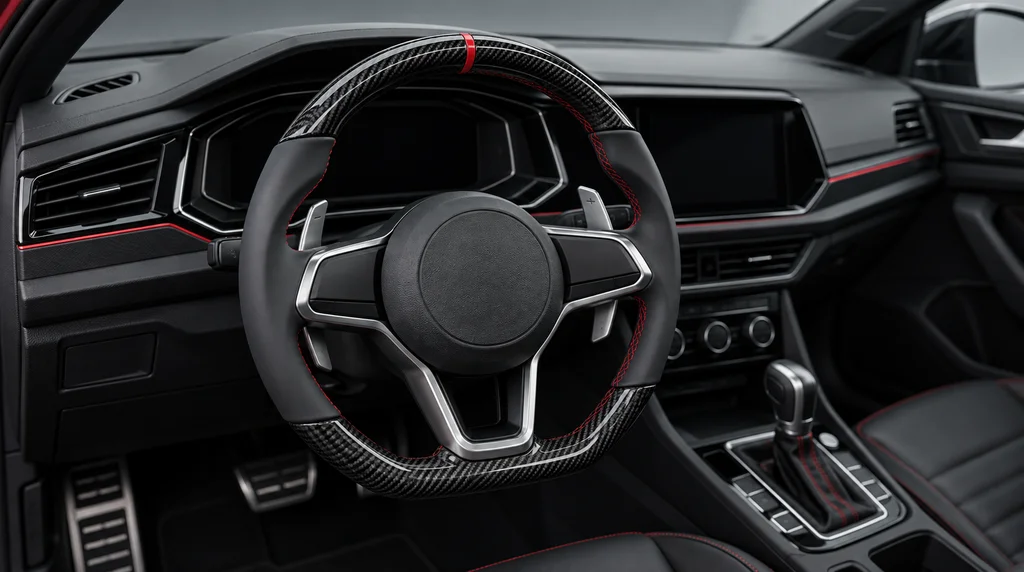
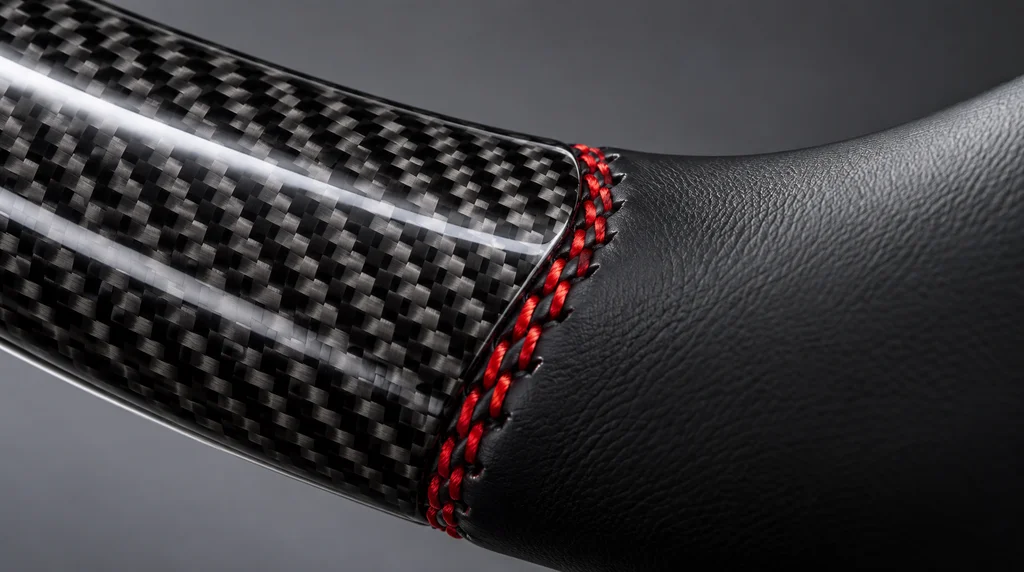
A gloss carbon section usually covers the top and bottom of the rim. Twill weave gives the classic diagonal look. The finish is decorative, not a grip surface. For a daily driver it works best as trim. Keep the side grips in leather or Alcantara. Tornado red stitching is the usual match for a GLI cabin.
Forged carbon has a marbled pattern rather than a woven one. The look is more subtle than gloss twill. It also hides fingerprints better. Owners who want a quieter cabin upgrade often choose it for that reason.
Alcantara offers the most grip and the least glare. The material suits a dark cabin and an enthusiastic driver. The trade-off is maintenance. The material absorbs oils from your hands. It needs a gentle brush and a damp cloth a few times a year.
Smooth leather is the closest match to what Volkswagen fits at the factory. The wheel never looks aftermarket. It is also the easiest finish to keep clean. Perforated leather adds ventilation where your hands sit if you prefer a cooler grip.
A flat-bottom rim changes the shape rather than the material. It frees knee room for taller drivers. You also get a clearer view of the instrument cluster on a lowered seat. The shape is the usual choice for a GLI. The flat section sits at six o'clock. It interferes with no factory function.
| Material | Grip | Maintenance | Best for |
|---|---|---|---|
| Gloss carbon trim | Low, decorative | Wipe clean | Visual upgrade with leather grips |
| Forged carbon trim | Low, decorative | Wipe clean | Subtler appearance |
| Alcantara | Highest | Periodic brushing | Enthusiast use, dark cabins |
| Smooth leather | Medium | Easiest | Long-distance comfort, factory look |
| Perforated leather | High | Leather care | Daily drivers in warm climates |
Compatibility for a VW Jetta steering wheel is not decided by the model name alone. Two A7 cars built a few years apart can differ. Button frames, paddle hardware and airbag connector keys all vary. Collect four things before you order. We need the VIN and a straight-on photograph of the wheel. We also need a photograph of the rear of the wheel. The airbag module should be removed by a qualified technician. Finally, list the options fitted to the car.
Those four items let us confirm the rim profile and button frame. We also confirm the connector type. We can then say whether the airbag module can be reused. Anything ambiguous means we ask for another photograph. We will not ship a wheel that may not fit.
You may worry about losing functions you use daily. A correctly specified wheel keeps the factory controls. The wheel is built around the original button frames and connector. The electronics are not replaced.
| Function | Typical outcome |
|---|---|
| Airbag | Original module normally reused; cover built to suit it |
| Multifunction buttons | Retained when the original button frame is reused |
| DSG paddle shifters | Retained on automatic cars; manual cars have no paddles |
| Heated rim | Depends on the heating element and trim; confirm first |
| Adaptive cruise buttons | Retained where the original frame carries them |
One point matters on these cars. Many Jetta models were sold with a manual gearbox. So paddles do not apply to those builds. Automatic cars use a different wheel family. Tell us which gearbox your car has.
There are two routes to a finished wheel. A donor-core build reuses your original wheel. We rebuild the rim with new carbon, leather and stitching. The structural core and button frames stay original. A complete replacement is built to the same dimensions. It leaves your original wheel untouched.
Donor-core builds are usually safer on newer cars. The electronics are untouched and fitment is proven. A complete replacement suits owners who want to refit the standard wheel before a sale. Both routes work if the donor matches your chassis and model year.
The material combination decides most of the visual character of a VW Jetta steering wheel. A well-balanced specification pairs gloss carbon with smooth black leather. The carbon covers the top and bottom of the rim. The leather covers the side grips. Tornado red stitching then ties the cabin together.
Drivers of an older 5N Tiguan often keep the whole rim in leather. The carbon is used sparingly. Those cabins are more traditional.
Round rims suit a Tiguan used mainly for family journeys. The rim is continuous at every steering angle. Flat-bottom rims suit GLI owners and taller drivers. The shape makes the interior look more purposeful. Neither shape changes how the car drives. It is a comfort and appearance decision, not a performance one.
Replacing a steering wheel involves the airbag. It is not a job to improvise. Disconnect the battery and power the vehicle down fully. Follow the manufacturer procedure for your chassis. The airbag module should be handled by someone who has done it before. Fasteners must be tightened to the specification in that chassis workshop manual. Never take a torque figure from a forum post or a general guide.
After fitting, check straight-line alignment on a test drive. Test every button and paddle individually. Test the horn as well. If a warning lamp remains, have the car scanned before driving further.
For warranty, the position is widely misunderstood. An aftermarket steering wheel does not automatically void a vehicle warranty under U.S. federal warranty law, but warranty coverage can still depend on whether the modification caused the specific failure being claimed.
Coding is one of the most overstated topics around steering wheel changes. The original steering wheel module, connectors and vehicle-specific parts may be reused. When they are, additional coding may not be required. A different module changes the picture. So does a different generation of button electronics. The car may then need a control unit update. The control unit has to be told what is now fitted.
It depends on your specific car. We treat coding as a conditional step rather than a promise. We need the VIN and photographs of both electronics sets. We will say whether a workshop visit is likely.
Nearly all problems trace back to a mismatch. The classic one is buying a wheel from a different generation. Some assume the button frame will transfer. It frequently will not. Another problem is a heated wheel on a car that never had one. The reverse happens too. You end up with an unused connector and a dead button. DSG paddle hardware is a third trap on automatic cars. Substituting the wrong set leaves paddles that do nothing. Cosmetic mismatches are easy to miss in photographs. A rim built for a GLI airbag cover may arrive with a standard cover. The four-item check above avoids all of these.
Often within the same platform generation, but not always. Button frames and airbag covers differ. Each car needs its own specification confirmed.
DSG cars do, and manual cars do not. Paddle hardware is specific to the wheel you have, so tell us which gearbox is fitted.
Often yes, but it depends on your original heating element and the trim you choose. We confirm this from photographs before building.
Only for a donor-core build. If you prefer to keep it, a complete replacement can be built instead.
Production typically takes 10 to 15 business days. International shipping usually adds a further 15 to 20 days. The overall window is roughly 25 to 35 days.
The original airbag module is normally reused. It is why the fitment check matters. The module is not modified. Installation must follow the manufacturer procedure for your chassis.
WELTHEIM designs and builds custom steering wheels at our own factory in Guangzhou, China. We have more than 13 years of experience across design, engineering and manufacturing. Every wheel is made to order. The materials, stitching and shape are specified by you. We confirm all of it against your chassis before production begins. We ship worldwide with tracking. Orders carry a 3-year warranty and a 30-day return policy, administered through an RMA request.
Our VW Golf GTI and Golf R guide covers the performance model lines and the same material choices. You can browse the catalogue in the shop. The Volkswagen entries sit under Volkswagen fitment, including the Jetta and Tiguan model pages.
We need the VIN and two photographs of the current wheel. Add the options fitted to your car. We will confirm the specification and lead time before we build your VW Jetta steering wheel. Two representative builds are the gloss carbon Jetta wheel with perforated nappa leather and the contrast stitched leather Tiguan wheel.
You can also read the installation guide. Our FAQ answers the common fitment questions. The about page explains how WELTHEIM builds wheels. Fitment and shipping questions go through the inquiry form or the contact page. Delivery expectations are set out in the shipping policy. Returns are handled under the return and refund policy. For the general position on modifications and warranty in the United States, see the FTC guide to federal warranty law. For airbag safety, see the NHTSA air bag pages.
A platform-by-platform guide to the VW Golf steering wheel upgrade: Golf 7 and Golf 8 GTI and R fitment checks, donor cores, factory functions and coding conditions.
Read More →