
The Volkswagen Steering Wheel Installation Guide
How to fit a Volkswagen steering wheel safely: isolating the battery, releasing the airbag module, marking the spline and testing the switches once the wheel is back on.
Read More →Guide · 10/19/2026
The three readings a Volkswagen custom wheel needs, how to take each one with the wheel still on the car, and the platform details that decide whether it fits.
A tape measure answers one question and leaves three open. Diameter is the number most owners send us, and it is rarely the number that decides whether a build feels right in the hand.
The same basic wheel was fitted across several platforms. This job is partly about the car, then, and partly about which generation of parts it carries. Both are covered below, in the order we ask for them.
Diameter, girth and dish are the three figures our pattern room works from. The first sets how large the rim is. The second sets how much of it your hand can hold, and the third sets how far the wheel projects towards you.
A fourth figure matters on some cars. Spoke angle decides where the covering can be stitched without pulling against the frame.
Most owners arrive with the diameter only. One figure starts a conversation and does not cut a pattern.
Nothing has to come off the car for this. Anyone searching Volkswagen how to measure a steering wheel is usually holding a tape and wondering where to put it.
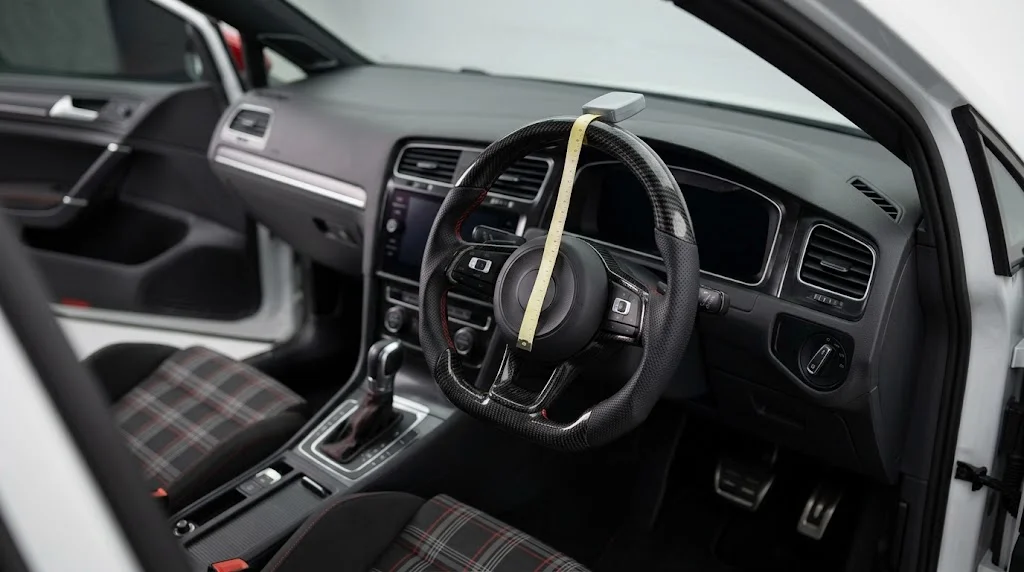
Straighten the front wheels, centre the rim, then hold the tape across the middle of the wheel at the height of the hub.
If the three readings disagree, the tape was not square across the centre. Start again rather than averaging them.
Wrap a soft tape around the rim section at the ten o'clock position, or use a strip of paper and measure it flat afterwards. The circumference is the girth, and it decides how the rim fills your hand.
The second half of Volkswagen how to measure a steering wheel is this number, and it is the one most owners never take.
A stock Volkswagen rim is slim by modern standards. Drivers who come from a larger car often describe the wheel as thin rather than small, and girth is the figure behind that feeling.
Girth can be increased on a rebuild without changing the diameter. This is the usual request from GTI owners who want weight in the palm and no change to how the car steers.
Dish is the distance from the mounting face to the centre of the rim. A deeper dish brings the rim closer to your chest and moves the spokes further from the stalks.
Measuring dish needs the wheel off, so we take it from photographs of the side profile rather than asking you to remove anything. A picture taken at hub height, from the driver's door, shows it well enough.
Spoke angle is the quiet one. A spoke that sits a few degrees off changes where a thumb rest can go, and it changes where the stitching seam can run.
Platform family narrows the answer before any tape is used. The table below is the one our fitment desk works from. It explains why two Golfs from different years can take the same pattern, and why a Jetta from the wrong side of a change cannot.
| Family | Typical cars | What carries over |
|---|---|---|
| PQ35 | Golf Mk5 and Mk6, early Tiguan, Jetta Mk5 | Column and airbag family, older button pods |
| MQB | Golf Mk7, Jetta Mk7, Tiguan Mk2 | Column shared across models, several airbag types |
| MQB Evo | Golf Mk8 and later | Newer touch pods and hands-on detection |
Golf, Jetta and Tiguan cars on the same family often share a column, which is why one build can suit three models. The airbag and the button pod still have to match, and those are the parts a tape cannot see.
Four things sit outside the measurement, and each one can stop a build. The airbag type comes first, because the cover is shaped around it.
The clock spring is second. A car with a heated rim or a hands-on sensor carries a different spring, and the connector count differs with it.
Button pods are third. A pair of wheels with the same diameter can carry pods with different connectors, and the difference only appears after fitting.
The fourth is the frame itself. A wheel from a different platform can share a diameter and bolt pattern and still sit at the wrong depth.
Three pictures cover what the numbers miss. Take one square on to the wheel face in daylight. Add one of the rear with the airbag out, and one from the driver's door at hub height.
The rear photograph is the one we study longest. It shows the frame, the connector shells, the paddle mounts if the car has them, and the shape of the airbag cavity.
Put the tape in the frame of the first photograph. A reading in the picture can be checked against the rim in the picture, which a number in an email cannot.
Households with a Golf and a Tiguan often order one wheel first and come back for a second. Measuring both on the same afternoon saves a second round of questions.
Write the readings against the registration of each car rather than against a nickname. Registrations get mixed up in one household more often than owners expect.
Cars on the same platform family may share one pattern. Cars on different families will show it in the readings before any money is spent.
Send the model, year and trim first, then the three readings and the photographs. A Volkswagen how to measure a steering wheel question is answered in a day when those arrive together.
Add the VIN. It narrows the option list to what the factory built, which is often shorter than the list of things the car could have had.
A rebuild that keeps the original module, the loom and the vehicle specific hardware is the case where further coding may not be needed. Everything the car talks to stays in place.
A wheel that brings a new button pod or a different sensor is the other case. The car may then need to be told what is fitted, and a workshop visit becomes likely. Coding is possible rather than certain, and the VIN plus photographs usually settle it before the build.
The faults we hear about most often come down to a short list. A Mk7 wheel on a Mk8 car can share a diameter and fail at the button pod. A heated rim brings a connector the plain rim does not have.
A wheel from a different family can sit deeper on the column than the original, which moves the stalks out of reach. A paddle car needs its mounts checked before the covering is cut, because the covering has to clear them.
None of these is visible on a tape measure. All of them show up in the rear photograph, which is why we ask for it before a pattern is drawn.
Six items cover the whole job, and five of them take under a minute.
Most modern Golf and Jetta wheels sit in a narrow band around the mid threes in centimetres, and larger SUVs sit slightly above it. The figure matters less than the platform, because the frame decides what will fit.
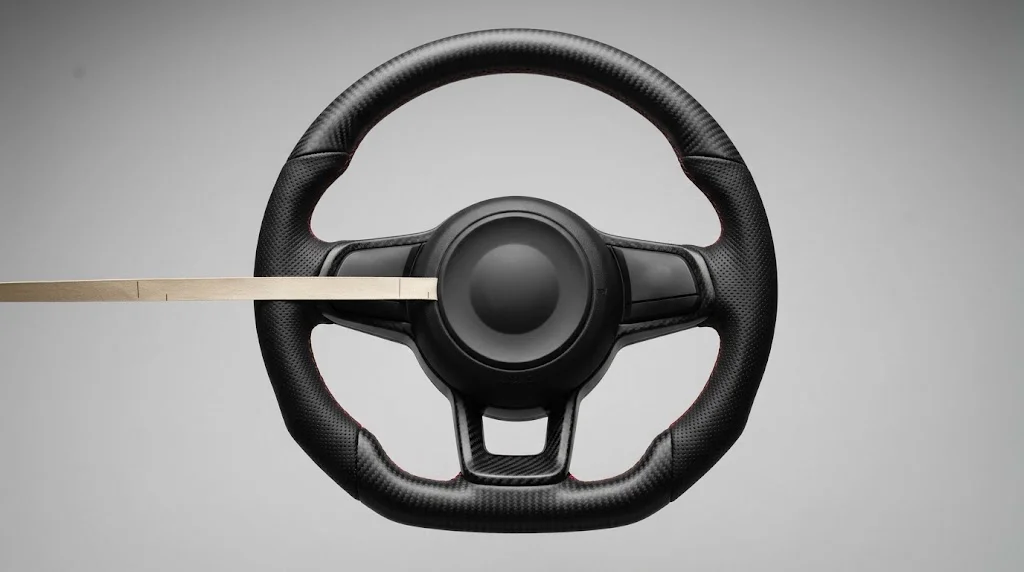
Outer edge to outer edge across the centre of the rim, taken three times with the wheels straight, then checked against the platform table.
No. Both of those are read with the wheel in place. Dish comes from a side photograph, which we read for you.
Yes. Girth is a covering and frame decision rather than a diameter one. The stock rim feels thin to many, and that is the request we hear most.
It raises the effort slightly at low speed. Owners notice it for a week and then stop thinking about it.
They will where the original pod is reused. A different pod may need coding, which is why the rear photograph matters.
Production runs ten to fifteen working days, then fifteen to twenty days in transit. The full window is twenty-five to thirty-five days.
Our workshop in Guangzhou cuts a pattern only after the platform, the airbag and the pod have been checked against your car. Nothing in the catalogue is a finished unit sitting on a shelf.
Thirteen or more years of design, engineering and production sit behind the frames we hold, from PQ35 columns to the newer touch pods. Covering, stitch, girth and diameter stay your decisions, and each one is matched to your VIN before the first cut.
Orders ship tracked worldwide with a three-year warranty and thirty days for a return on an RMA request. The desk that answers a measuring question is the desk that checks the pattern.
More on this site follows the same thread. The materials comparison covers the coverings once the size is settled. The Golf, GTI and R guide sets out the trims by year. The gloss and matte guide answers the finish question that usually follows.
The catalogue sits in the shop. Pages worth opening are the brand listing, the GTI page, the Tiguan page and the Jetta page.
Put the tape on the rim, take the picture in daylight and send it with the VIN. A Volkswagen how to measure a steering wheel question gets an answer within a day when the numbers and the pictures arrive together. A confirmed pattern and a build date come back before any work starts on your Volkswagen steering wheel.
Two builds suit the readings above. The Alcantara wheel listed for the GTI, GTD and GTE is the one to look at when girth is the complaint. The forged carbon wheel for the later Mk7 Golf and GTI keeps the stock diameter with a different finish and a thicker section.
Background reading sits in the installation guide, the FAQ and the about page. Fitment and delivery questions can go to the contact page or the inquiry form. The shipping policy lists the transit window, and the return policy covers a return. The federal warranty standard sits in 15 U.S.C. 2304, with the related interpretations in 16 CFR Part 700.
How to fit a Volkswagen steering wheel safely: isolating the battery, releasing the airbag module, marking the spline and testing the switches once the wheel is back on.
Read More →How to clean carbon fiber and Alcantara on a Volkswagen steering wheel: a ten minute weekly routine, the cloths to use, and the products that harm both surfaces.
Read More →How carbon fiber, Alcantara, perforated leather and Nappa behave on a Volkswagen steering wheel, and which mix suits a Golf GTI, Golf R or Tiguan.
Read More →